Friday, October 8, 2010

Current Palladium fundamentals

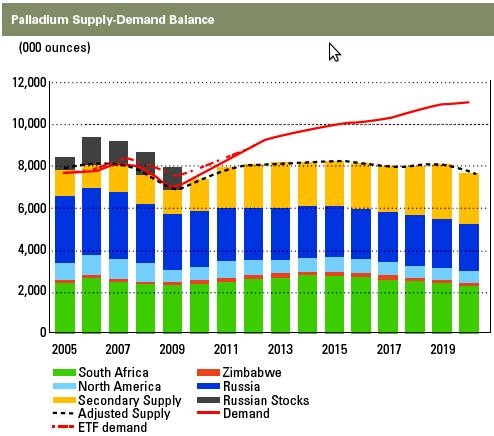
As global economic recovery, albeit anemic, takes hold demand for palladium has improved. GM now sells more cars in China than the US and with the number one use for palladium being in catalytic converters this bodes well for the demands side of the market.

Mine production is still less than what is demanded globally. The gap in the past has been coming from depleting Russian stockpiles. While still a state secret the Russian stockpile is rumored to be nearly depleted, possibly next year. The last time the Russians stopped selling it was thought that they were running out of supply and the price spiked to over $1000 per ounce.

On the demand front the palladium ETF (PALL) launched earlier this year in the US has been accumulating inventory as well.

A bill in the US house has passed paving the way for a Palladium bullion coin to be minted. The mandate is that the palladium is to be sourced domestically, primarily from the Stillwater complex in Montana.

Russian stockpile :

There may not be enough stockpiles of palladium held by the Russian
government to enact sales in 2011, according to Anton Berlin, marketing
director Norilsk Nickel.

Talking on a conference call hosted by ETF Securities, Berlin said market
perception of Russian state stockpiles of palladium is that there is possibly
no metal left to sell in 2011. Although it is impossible to know exactly how
much palladium is left in government stocks, sales have slowed over the last
two years. Berlin added that it is possible the stockpiles are close to
depletion.

The issue of Russian stocks has been a market driver for many years, with
a lack of certainty as to how much material they contain.

The holder of stocks is the Ministry of Finance. Traditionally, sales out
of the country's stockpile have compensated the current gap between production
and use.

Looking at other "on-ground" stocks, Berlin said the fact that
Switzerland--the historic hub for precious metals vaulting--experienced a
drawdown of 800,000 ounces between January and July, was "remarkable."

"It's quite substantial," he said.

Berlin added that it is an indication of material being consumed faster
than it can be produced.

Palladium bullion :

Creation of a new U.S. palladium bullion coin was authorized by the House of Representatives Sept. 29.

If the Senate concurs, a new one-ounce coin would have as its obverse design the A.A. Weinman Winged Liberty design that was used on the dime popularly called the Mercury dime 1916-1945. For the palladium coin, though, it would be in high relief.

The legislation calls for a reverse design that would be a high relief version of the reverse design of the 1907 American Institute of Architects medal.


Face value of the new coin would be $25, though an ounce of palladium is currently worth $571. Designation of face value is intended to give the coin legal tender status and not serve as an indicator of actual value.

More analysis from seeking alpha.

Friday, September 17, 2010

Peak everything?

Interesting, like all forecasts I am rather skeptical on accuracy.

What's Left?Powered by Ergo:Ux

Friday, June 11, 2010

Comprehensive breakdown of the Physical Gold Market

This research summarizes some important facts and history of the gold market and overall current market dynamics.


Passport Capital Physical

Tuesday, June 8, 2010

History can add perspective.

Haven't We Been to This Show Before- Dan Alpert-Westwood

Draw parallels where you may, the author makes ample comparisons, but all too often studying history is less of an economic tool than what current economic theory is dictating to be done.

For a day by day account of the depression era check out news from 1930
It provides a summary of news day by day to get a granular perspective of the evolution of the Great Depression.

Friday, June 4, 2010

Hogwash is full of Bubbles.

I keep reading about how gold is supposedly in a bubble. This claim is plastered acrossed financial blogs and publications not to mention TV talking heads with stronger opinions than investment track records.

So let's explore this assumption:

First from google news

gold bubble:689 articles
treasury bubble:383 articles

Unless you think that interest rates will go negative and bonds will rally forever the latter scenario with less chatter is of higher probability of being true.

Second, gold costs money to produce so how much does it cost?

The average cost in 2009 was $457 down from $623 in 2008 due to higher oil prices. Mind you while these costs may seem low compared to the spot price of gold, the money made from other metals that are extracted with the gold are subtracted from the cost; so much so in some cases like silver miners they can have a negative cash cost when the silver ore has a high concentration of zinc or lead.
Profit margin gold miners: 27.1% from the most recent data I could find in 2008 and for 2009 some of the major producers were as follows:
Barrick 29.6%
El dorado 29.1
Newmont 24.35%
kinross 16.8%
Anglogold 14%

Now for other industries
Big Pharma: 21.7%
Software: 21.1%

Microsoft 27.6%
Intuit 35%

Johnson & Johnson 29%
Eli Lilly 22.8%

Hey where are the articles about the software and pharmaceutical bubbles!

The idea that gold is over priced as Miami condos during the boom or internet stocks in the late 90'S is hogwash. If the argument is that gold is overpriced fine, that can be evaluated upon merit.
I would like to see if any of the talking heads called the bottom in gold in 2000 since they are so quick to call a top. I doubt they bought at the top or willing to put their money where their mouth is and short the "bubble". Talk is cheap, but we sure didn't hear much when gold was.

Tuesday, May 18, 2010

Motivation!


This is a surprising, paradoxical analysis of what motivates us. Carrot and stick motivation doesn't drive innovation. Creativity is driven much more from within than any profit motive can extract.

Wednesday, May 5, 2010

Waxing Existential

I stumbled across two interesting pieces while perusing the web an though it would be more fitting to put together for even greater perspective.:


A Brain Cell is the Same as the Universe
by Cliff Pickover, Reality Carnival

Physicists discover that the structure of a brain cell is the same as the entire universe.

"Oh God, guide me, protect me; make of me a shining lamp and a brilliant star." -- Abdu’l-Bahá

Original article here

A piece from Wired magazine

"Few ideas are so preposterous that no one at all takes them seriously, and this idea — that God, or at least the universe, might be the ultimate large-scale computer — is actually less preposterous than most. The first scientist to consider it, minus the whimsy or irony, was Konrad Zuse, a little-known German who conceived of programmable digital computers 10 years before von Neumann and friends. In 1967, Zuse outlined his idea that the universe ran on a grid of cellular automata, or CA. Simultaneously, Ed Fredkin was considering the same idea. Self-educated, opinionated, and independently wealthy, Fredkin hung around early computer scientists exploring CAs. In the 1960s, he began to wonder if he could use computation as the basis for an understanding of physics."

The gist of the piece is that the universe is a super computer and the more you delve into that hypothesis the harder it is to rule out.

While for years the clockwork of the universe is often explained with bell curves, standard deviations and probabilities; fractal geometry gives a different representation of more and more granularity and detail the closer you inspect.

As an awe inspiring mountain from 30,000 feet can be reduced to a collection of rocks and boulders on close inspection; the machinations of the cosmos can be reduced to its infinitesimally small counterpart the neuron.

Tuesday, April 20, 2010

Palladium

From the 2009 Stillwater mining annual report:

Still Water Palladium 2009