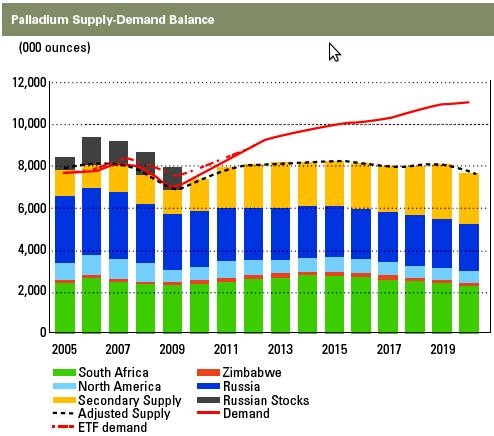
Mine production is still less than what is demanded globally. The gap in the past has been coming from depleting Russian stockpiles. While still a state secret the Russian stockpile is rumored to be nearly depleted, possibly next year. The last time the Russians stopped selling it was thought that they were running out of supply and the price spiked to over $1000 per ounce.
On the demand front the palladium ETF (PALL) launched earlier this year in the US has been accumulating inventory as well.
A bill in the US house has passed paving the way for a Palladium bullion coin to be minted. The mandate is that the palladium is to be sourced domestically, primarily from the Stillwater complex in Montana.
Russian stockpile :
There may not be enough stockpiles of palladium held by the Russian
government to enact sales in 2011, according to Anton Berlin, marketing
director Norilsk Nickel.
Talking on a conference call hosted by ETF Securities, Berlin said market
perception of Russian state stockpiles of palladium is that there is possibly
no metal left to sell in 2011. Although it is impossible to know exactly how
much palladium is left in government stocks, sales have slowed over the last
two years. Berlin added that it is possible the stockpiles are close to
depletion.
The issue of Russian stocks has been a market driver for many years, with
a lack of certainty as to how much material they contain.
The holder of stocks is the Ministry of Finance. Traditionally, sales out
of the country's stockpile have compensated the current gap between production
and use.
Looking at other "on-ground" stocks, Berlin said the fact that
Switzerland--the historic hub for precious metals vaulting--experienced a
drawdown of 800,000 ounces between January and July, was "remarkable."
"It's quite substantial," he said.
Berlin added that it is an indication of material being consumed faster
than it can be produced.
Palladium bullion :
Creation of a new U.S. palladium bullion coin was authorized by the House of Representatives Sept. 29.
If the Senate concurs, a new one-ounce coin would have as its obverse design the A.A. Weinman Winged Liberty design that was used on the dime popularly called the Mercury dime 1916-1945. For the palladium coin, though, it would be in high relief.
The legislation calls for a reverse design that would be a high relief version of the reverse design of the 1907 American Institute of Architects medal.
Face value of the new coin would be $25, though an ounce of palladium is currently worth $571. Designation of face value is intended to give the coin legal tender status and not serve as an indicator of actual value.
 |
| More analysis from seeking alpha. |